Streamlined Steam & Lehigh Valley Locomotives
The first pic got me researching the Illinois Central Green Diamond – which was initially pulled by a stylish Pullman diesel electric (first set of pics). But I detoured early on into Lehigh steam. When I went back to the streamlined locos, I stuck to mostly steam. …So it was a bit of an eclectic research effort. Let’s start with the streamlined locos, and you’ll later get to see the Lehigh Valley pics.

The Illinois Central Green Diamond, built by Pullman Standard, was introduced in 1936, and retired in 1950. The Green diamond was a five car articulated train similar to a few others Pullman built in the ‘30s.

Here’s a pic that gives a good view of both the locomotive, IC #121, and the two tone green color scheme. #121 pulled the train from it’s debut in 1936 to 1947. The articulated equipment was replaced in 1947 with more conventional equipment, and the Green Diamond continued to run with the more conventional equipment until 1968.
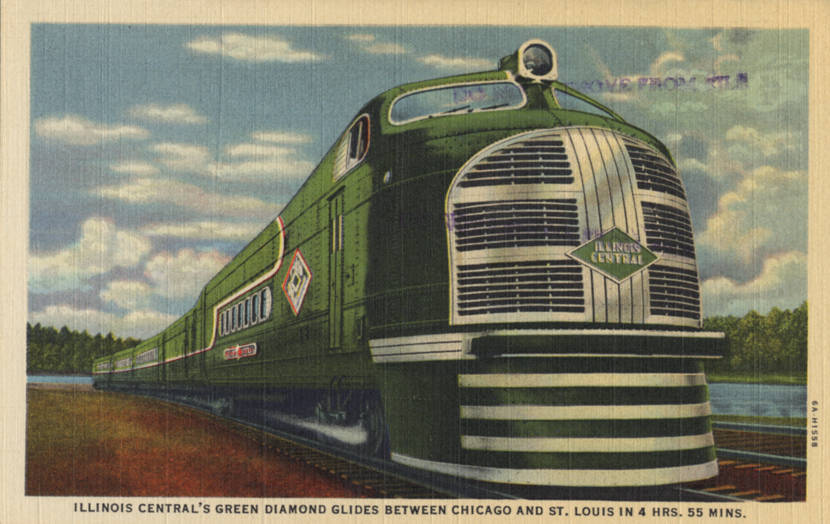
The trip from Chicago to St. Louis is roughly 300 miles (294 rail miles). So the just under 5 hour trip means the train was averaging 59 mph. Top speeds were probably over 80 mph.

This is the Gulf Mobile & Ohio diesel-electric 4-S built by Ingalls Shipbuilding. We looked at this loco back in July 2021. The 4-S was seen pulling 3 to 4 car passenger trains (besides a number of other duties). Though it’s not really a streamliner, the front cab does a nice substitution
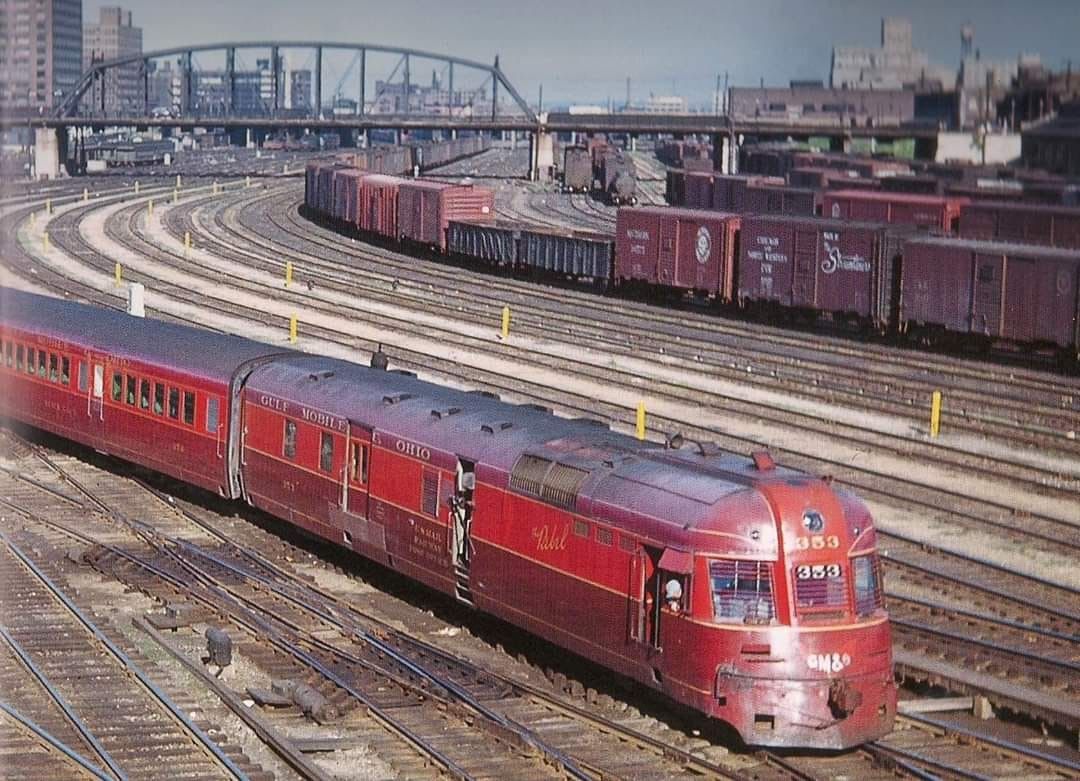
The Rebel was GM&Os named passenger service. There were three different Rebel runs – and in turn three streamlined diesel-electric locos. American Car and Foundry built the three engines. Here is GM&O #353 pulling the Rebel.

GMO #352 & #353 were built in 1935, and #354 was built in 1937. GM&O chose not buy articulated streamliners because operations required adding and removing cars in the consist. So they bought these streamlined locos to pull a matching set of passenger cars.

The American Car and Foundry locos were eventually replaced by Alco DL-105s. GM&O #270, built 1940, pulls the Rebel through New Orleans. 1951.

This photo provides a better look at the unique appearance of the DL units.

Though not a streamlined loco, I had to throw in this pic of GM&O #5296, a 4-6-2 sporting a unique color scheme, circa 1947. (The photo says 1947, but that might be right at the formation of the GM&O – if I have my dates correct!)

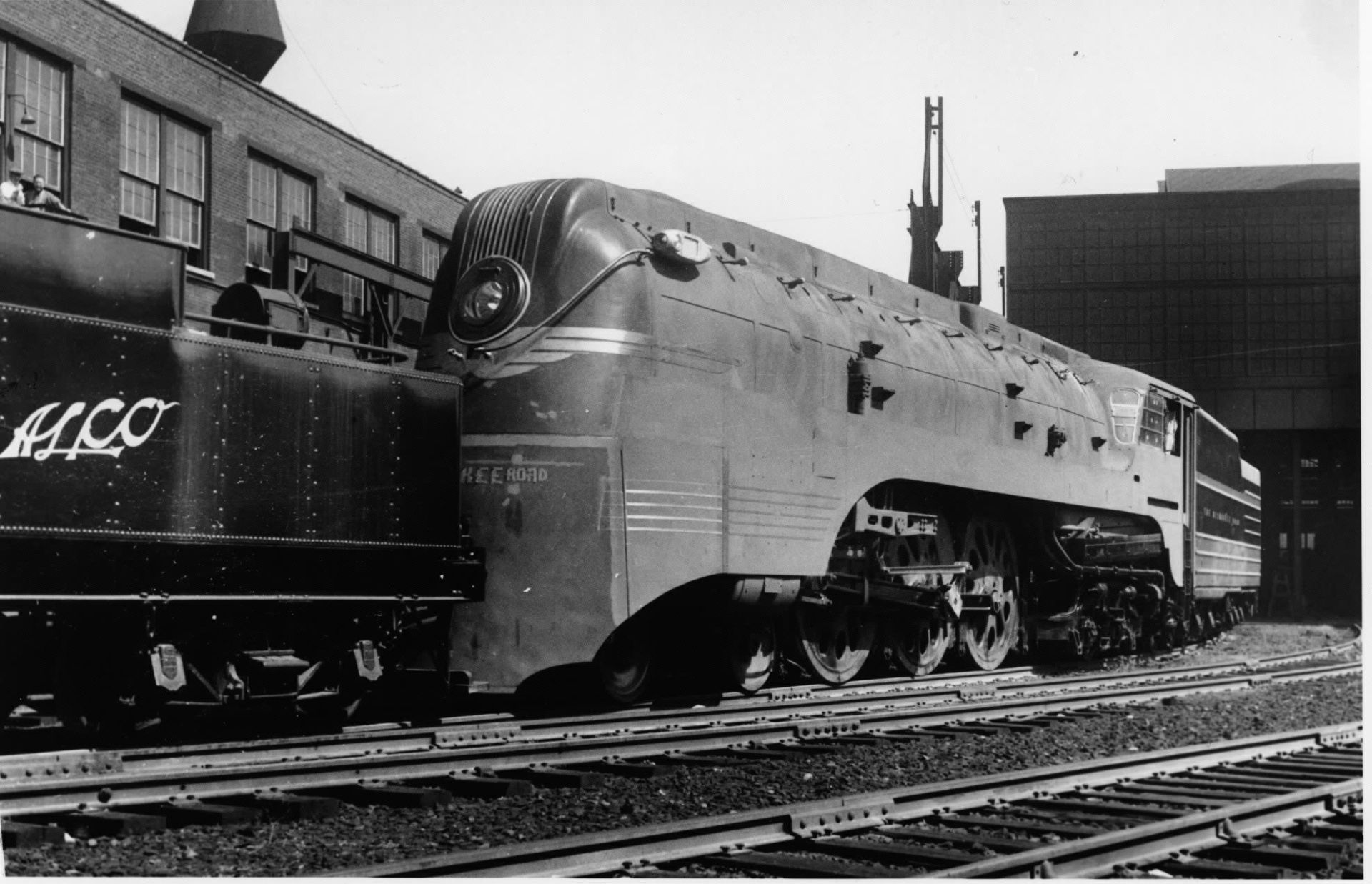
Milwaukee #4 is a Class A streamlined 4-4-2. Alco built 4 of these for Milwaukee from 1935 – 1937, all but #3 were retired in 1951. #3 was retired in 1949 to use as parts for the other three. These were some of the last 4-4-2’s built in the US, and some of the largest and most powerful 4-4-2’s. They were designed for daily operation over 100 mph. They were built as streamlined locomotives, and hence ran their entire life with the streamlined casings. They made the run from Chicago to St. Paul in a scheduled 6.25 hours pulling up to 9 passenger cars. Though never officially recorded, they are believed to have run at speeds over 120 mph with a possible top speed over 125 mph – the fastest speed recorded was 112.5 mph.

Here’s #1. It’s hard to perceive the size of the 84” diameter drivers while they’re behind the cowling.

…and a postcard image of #2:
The A class lead the way for the Milwaukee F7 class Hudsons (4-6-4s), numbered 100 to 106, built in 1938 by Alco. The streamlined Hudsons were also retired in 1949 to 1951. Milwaukee referred to these Hudsons as “Baltics”. They also ran over 100 mph for extended periods with a recorded top speed of 126 mph in 1938. From a write-up, “On July 27, 1950, F7 #102 was on a run between Chicago and Milwaukee on the “North Woods Hiawatha.” 73 miles from Milwaukee, the right main crosshead froze in its guide. It immediately overheated, broke, and dropped from the guide while the train was traveling at an estimated speed between 90 and over 100 mph. Air brake lines were severed, putting the engine into emergency. The engine was severely damaged, broken drive gear tore up ties and roadbed, and debris (including the main rod) was found as far as 1400 feet west of Edgebrook Station. … Whatever the case, no one was killed. The train stayed on the rails, and continued to over 10,560 feet from the station until coming to a complete stop.”

…#104 pulling the Hiawatha:

Another fascinating streamliner was the Reading Crusader. The Crusader was pulled by one of two streamlined Pacifics (4-6-2s). This is #117, the first of two of the Class G1sas Pacifics built in 1937.

Here’s #118:

…and in color (not sure if this is #117 or 118):

The Reading was not known for it’s passenger service, but another earlier streamlined Pacific shows up on their roster. #108, Class G1sa, was built in 1934.


That brings us to the Lehigh Valley #2102, a Baldwin Class K-5 Pacific, built in 1916. Older Pacifics LV #2101 and #2102 were streamlined in 1939 as part on effort to modernize the LV’s two named passenger trains: the John Wilkes and the Black Diamond Express. #2101 and #2102 pulled the John Wilkes

…the new streamlined John Wilkes with LV #2102 at the head, being introduced in 1939.

Also part of the modernization plan was streamlining K-6 Pacifics #2089, #2093, and #2097 for pulling the Black Diamond Express. #2093 and #2097 were built in 1924 by Alco. LV #2089 was unique in that it was the last locomotive built at the LV Sayre shops in 1925. All three Pacifics were streamlined in 1940. Here is a colorized photo of LV #2089 pulling the Black Diamond through the snow at Rochester Junction

The LV dieselized their entire passenger service in one large swoop in 1948 by purchasing 14 Alco PA-1s. Here LV #612 heads a passenger run.
The LV dieselized their entire passenger service in one large swoop in 1948 by purchasing 14 Alco PA-1s. Here LV #612 heads a passenger run.

My fascination with Lehigh Valley steam started with the streamlined K-5s and K-6s, but jumped up a notch when I saw this loco: The LV “Janus”, #164, was an 0-6-6-0 built in 1871 by Mason Machine Works. “Janus” is a unique double Fairlie locomotive originally designed for the Central Pacific, but is believed to never have run on Central Pacific track. The LV acquired it and it’s thought to have been used as a pusher. Being double-headed, it didn’t have to be turned around for return trips. Rumor was that it was wrecked in 1877 and the boiler was used as a stationary power source. But other sources claim that the LV split it into two separate 0-6-0 steamers. Another source says it was rebuilt into a 0-6-6. The biggest issues with “Janus” was limited water and fuel. But it was part of the development line for double boilers and articulated drivers.

We chuckle at Matt’s cab forward switcher, but here’s the prototype! Lehigh Valley only owned two 0-4-0 switchers. Being a long haul coal railroad, they didn’t have much of a need for small switchers. The first of the LV 0-4-0 switchers was built in 1857 by Cooke. #3500, a class B-1, was built by Brooks in 1906 and scrapped in 1939. I’m not sure of the interior cab arrangement, but the cab exterior was designed like a cab forward. Again not knowing for sure, it could be that as a switcher, it was designed for both directions. Being a saddle-tanker helped during cab forward movement!

The “Jupiter” was built in 1870 in LV shops at Hazleton. This 0-8-0 was a more typical switcher for the LV being able to handle the weight of heavy coal trains. LV bought 0-8-0s starting in 1855, almost from the beginning of the railroad. In fact LV #1 was a 0-8-0. Early use of the 0-8-0s were road engines, but as more powerful steam developed, they became workhorse switchers.
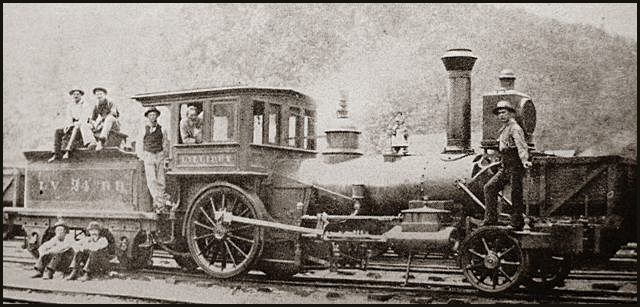
With the LV niche being coal hauling, hence the many early 0-8-0s, I’m not sure what LV #24 “Lilliput” was built for! The “Lilliput” was a 2-2-0 built in 1862 by Mason Machine Works.

LV #63 was not only a 2-8-0 consolidation, but it was THE “Consolidation” – the first ever consolidation. The name “Consolidation” came from the merger of the Lehigh Valley with the Lehigh & Mahanoy RR. #63 was designed by an L&M engineer who was looking at the heavy hauling requirements of the L&M/LV. It was built in 1866 by a skeptical Baldwin, but turned out to be a great success – Consolidations ended up the most popular wheel arrangement in the history of steam. “Consolidation” ran for 46 years until it was retired in 1912.

Whenever there are camelbacks on the roster, I have to study at least one. Here’s LV #3066, an 0-8-0 built in 1906 by Alco. Interestingly, #3066 wasn’t scrapped until 1940 – we learned in an earlier research project that camelbacks disappeared from service in the ‘20s.

The “Potter”, #436, an 0-6-0T switcher, was built in the LV Hazleton shops in 1884. This loco gives you an early view of a saddletanker.

Check out these two early decapods, 2-10-0s, built by Norris in 1867. LV #81 is the “Ant”. The “Ant” was rebuilt into a 4-8-0 in 1880. Then it was rebuilt again into a ten wheeler in 1905. It ran until 1912.

LV #82 is the “Bee”. The “Bee” was rebuilt in 1883 to become the first Mikado, 2-8-2. Then it was rebuilt again into a 2-8-0w in 1889, but was off the roster by 1893

Here’s the “Bee” after it was rebuilt into the first Mikado.

One of the earliest inspection engines was the Lehigh Valley’s “Cricket” built at the LV’s shops in Hazleton in 1870. This is the only known photo, but the “Cricket” had a sister engine that worked for the Reading – the Reading “Black Diamond” has been preserved and can be seen today in St. Louis.

More famous was the inspection engine “Dorothy” built in 1884, and not retired until 1934. The caption with this photo relates back to the earlier photo of the odd looking “Lilliput”: “Could the ‘Lilliput’ have been rebuilt into ‘Dorothy’? it’s possible! Dorothy was built in 1884 at the Wilkes Barre shops, and Lilliput is indicated as ‘scrapped about 1885’, so the dates are interesting. Also, there is the notation that the Lilliput was rebuilt into a 4-2-4T. And, the drivers of Lilliput and Dorothy appear to be identical! and the smokebox (front of the boiler) looks very similar. It has been assumed that Dorothy was built from scratch, but it’s possible that the Lilliput gave her drivers and boiler to Dorothy! This is however merely speculation at this point, but it’s an interesting theory!”

The Mastodons, 4-8-0s, are another wheel arrangement not seen often. LV #20, “Champion” was built in the LV Weatherly shops in 1880.

LV #378, “Cheyenne” was built in the LV Weatherly shops in 1882.

The “Shoo Fly” was a 0-4-4T built by Mason Machine Works in 1873.

Getting back to the streamlined passenger service, the Black Diamond Express was first pulled by a 4-4-0 camelback 1896. But these 4-4-0s weren’t quite capable, so they were switched out with the new Atlantic 4-4-2 camelbacks. LV #668 was built by Baldwin in 1896 and though not streamlined, it has a sleek powerful look to it.

Part of the reason there were odd locos seen on the Lehigh Valley was that they both built quite a few of their own locos, and they also designed locos and then had companies like Alco and Baldwin build them. Their requirements ran off of the heavy loads and steep grades they fought pulling coal to the industrial centers. Though most of the unique steam seen above were built in 1800s, they continued to build their own locos well into the 20th century. The LV shops in Sayre, PA were built in 1904 as a consolidation of all the dispersed LV shops of the 19th century. Locos were built here until 1925, and the last of those locos remained in service until 1976. The shops were demolished in 1987/88.
There’s a lot more info at the website listed above.
Thx,
Kevin

Comments